
Your transmission is one of the hardest working parts of your car, and it rarely asks for attention until something goes wrong. When it does start to fail, the first signs are often subtle: an engine that revs a little higher than it should, a gear change that feels odd or a hesitation when you press the gas. Those early hints are the best time to act, because a transmission that is slipping tends to get worse, and heat makes it worse faster. Mesa summers push every transmission close to its limits. This guide explains what transmission slipping is, the early warning signs, how heat plays a part, what to do if you notice a problem and how repairs usually work. If you are searching for transmission repair in Mesa, AZ, here is a plain language overview.
What a Transmission Does
The transmission takes power from the engine and delivers it to the wheels, using different gears or ratios to match your speed and the load on the car. In an automatic transmission, a combination of fluid pressure, clutches and bands, along with a computer, shifts between gears for you. Many modern cars use continuously variable or dual clutch designs, which work differently but share one need: they depend on clean fluid at the right level and the right temperature.
What Does Slipping Mean?
A transmission slips when it fails to hold a gear or fully transfer the engine’s power to the wheels. The engine speed rises, but the car does not accelerate the way it should. It feels as if the car has briefly slipped into neutral. Slipping can happen in one gear or several, can come and go, and often starts out mild before it becomes constant.
Early Warning Signs of Transmission Trouble
- Engine revving without matching acceleration. The tachometer jumps, but the car responds slowly.
- Delayed engagement. There is a pause before the car moves after you shift into drive or reverse.
- Harsh, jerky or late shifts. Gear changes feel rough, or happen at odd moments.
- Shifting back and forth. The transmission seems unable to settle on a gear.
- Shuddering or vibration at certain speeds.
- Whining, humming or clunking noises, especially when shifting.
- A burning smell. Overheated fluid has a sharp, burnt odor.
- Reddish or brownish fluid under the car. Transmission fluid is often red when new, and darkens with age.
- Dark, gritty or burnt smelling fluid if you are able to check it.
- A warning light. A check engine light or transmission temperature light can come on.
- The car entering a limp mode, where it stays in one gear to protect itself.
- Poor fuel economy because the engine works harder than it should.
Any one of these signs can have more than one cause. A sensor problem, a software issue, low fluid or an engine problem can mimic transmission trouble, so a proper diagnosis matters before anyone starts replacing parts.
What Heat Has to Do With It
Heat is the biggest enemy of an automatic transmission. Fluid that is too hot loses its ability to lubricate and cool, the friction material in the clutches wears faster and rubber seals harden and leak. Once the fluid breaks down, it cannot carry heat away as well, and a cycle begins that can wear a transmission out quickly.
Mesa has several things that drive temperatures up:
- Hot ambient air. The transmission starts out in a hot engine bay and has less room to shed heat.
- Stop and go traffic. Constant shifting, and low airflow while crawling, builds up heat.
- Towing and heavy loads. Pulling a trailer or carrying a full load puts extra strain on the transmission.
- Climbing grades with the air conditioning on. The engine and transmission work harder together.
- Old or low fluid. Fluid that is past its service life does not handle heat well.
- A struggling cooling system. Many transmissions rely on the radiator or a separate cooler to remove heat, so a cooling problem can affect the transmission too.
Our article on summer car maintenance tips covers the broader checklist for keeping a car healthy through the hottest months, including the cooling and fluid items that protect the transmission. Heat also works the air conditioning hard, and our guide on why Mesa drivers should check their AC before summer hits is a useful companion, since both systems share the stress of a hot day.
Checking Transmission Fluid
Fluid is the simplest place to start, though the method differs from car to car.
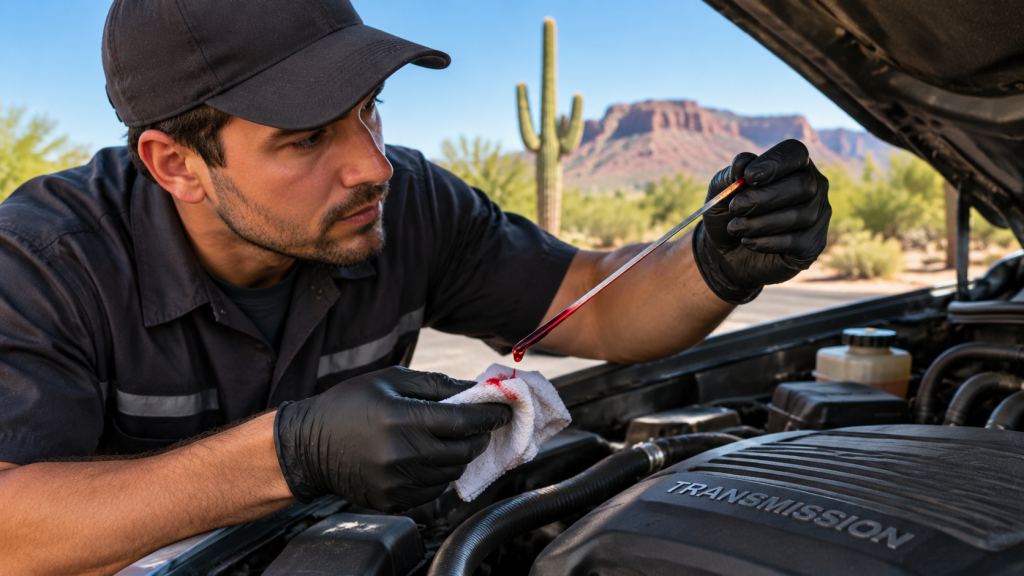
- Some cars have a dipstick, and your owner’s manual explains whether the engine should be running, warm or in a certain gear when you check it.
- Many newer cars have a sealed transmission with no dipstick, and a technician needs to check the fluid.
- Look at the color and smell. Fluid that is dark, cloudy, gritty or burnt smelling is a concern. Bubbles or foam can also point to a problem.
- Never guess the fluid type. Transmissions are sensitive to which fluid they use, and the wrong kind can cause damage. Your manual lists the correct one.
Low fluid usually means there is a leak. Topping off without finding the leak only delays the problem.
What to Do If You Think Your Transmission Is Slipping
- Do not ignore it. Slipping rarely fixes itself, and driving on a slipping transmission can cause more damage.
- Reduce the load. Avoid towing, hard acceleration and long trips until it is checked.
- Check for leaks and the fluid, if your car allows it and you can do it safely, with the engine cool where required.
- Note what you feel. When does it happen, in which gear, hot or cold? Details help a technician.
- Get it inspected soon. Early diagnosis often means a simpler fix.
If the car will not move, shifts violently, smells strongly of burning or a warning light appears along with serious symptoms, stop driving and arrange help. Your owner’s manual explains what the lights on your dashboard mean for your vehicle.
What a Technician Checks
- Fluid level, condition and leaks.
- A code scan, since the transmission computer often stores helpful information.
- A road test, to feel when and how the slipping happens.
- Sensors, solenoids and wiring, which can cause shifting problems.
- Cooling system and the transmission cooler, to make sure heat is being removed.
- Engine mounts and related parts, which can cause vibration that feels like a transmission issue.
- Pressure tests, when needed, to see whether internal parts are holding pressure.
Common Causes of Slipping
- Low or leaking fluid. Worn seals and gaskets or damaged lines can let fluid escape.
- Old, burnt or contaminated fluid.
- Worn clutches or bands. The friction material wears down over time.
- Faulty solenoids or sensors.
- Torque converter problems.
- Internal wear or damage.
- Software or control problems.
- For a manual transmission, a worn clutch is a common cause of slipping.
Repair Options
What your car needs depends on the cause. A technician may suggest one of several routes:
- A fluid service, where the fluid is changed and sometimes the filter is replaced, if the condition and the design of your transmission suggest it will help. This is not always the right answer, and a technician can advise whether it is appropriate for your car.
- Repairing leaks, such as replacing a seal, gasket or line.
- Replacing sensors or solenoids, where electrical or control problems are found.
- Clutch replacement on a manual.
- A rebuild or replacement, when internal parts are badly worn.
Ask for a clear explanation of the findings and the recommended repair, and follow your owner’s manual for service intervals and fluid type. A trustworthy technician will tell you what is certain, what is likely and what needs further testing.
Can a Mobile Mechanic Help With Transmission Problems?
For many of the early steps, yes. A mobile mechanic can come to your home or workplace in Mesa to scan for codes, check fluid, look for leaks, inspect the cooling system and talk through what is going on. Some repairs, such as certain fluid services, sensors, solenoids and some leaks, can be handled on site. Internal repairs, rebuilds and replacements need a lift, specialized tools and a controlled workspace, and are usually a shop job. A good technician will tell you which applies to your car and will not attempt work that needs a shop.
How to Protect Your Transmission in the Desert Heat
- Follow the transmission fluid service schedule in your owner’s manual, and look for any severe driving schedule that mentions heat, towing or heavy traffic.
- Use the right fluid.
- Keep the cooling system healthy. Check the coolant and have leaks fixed.
- Do not tow or haul beyond your vehicle’s limit listed in the manual.
- Let the car warm up gently, and avoid hard acceleration with a cold or very hot transmission.
- Do not rock the car between drive and reverse before it has fully stopped.
- Fix leaks promptly.
- Do not ignore small symptoms, such as a delay in engagement or an unusual noise.
Quick Summary
- Slipping often feels like the engine revs without the car responding.
- Other signs include delayed shifts, harsh shifting, shudders, odd noises, burning smells and leaks.
- Heat breaks down fluid and wears clutches, so desert summers raise the risk.
- Do not ignore symptoms, since a small problem can grow.
- Some checks and repairs can be done at your home, and internal work needs a shop.
The sooner a transmission problem is looked at, the more options you tend to have. If you would like help, visit the Mobile Mechanic Pros of Mesa homepage to learn more, or get in touch with the team to schedule a visit.